EA FC 25’s TOTY Update: The Patch That Dared to Mess with Golden Goal
The frosty January transfer window of 2026 has gamers still buzzing about a moment from last year that split the Ultimate Team community like a well-timed through ball. EA Sports dropped a Title Update for FC 25 that almost everyone agreed was the ‘best patch in FIFA history’ – only to then slide in a sly objective that made players spit out their energy drinks. It was a classic case of one step forward, one step back, and the whole saga still serves as a cautionary tale about what happens when developers meddle with unwritten rules.
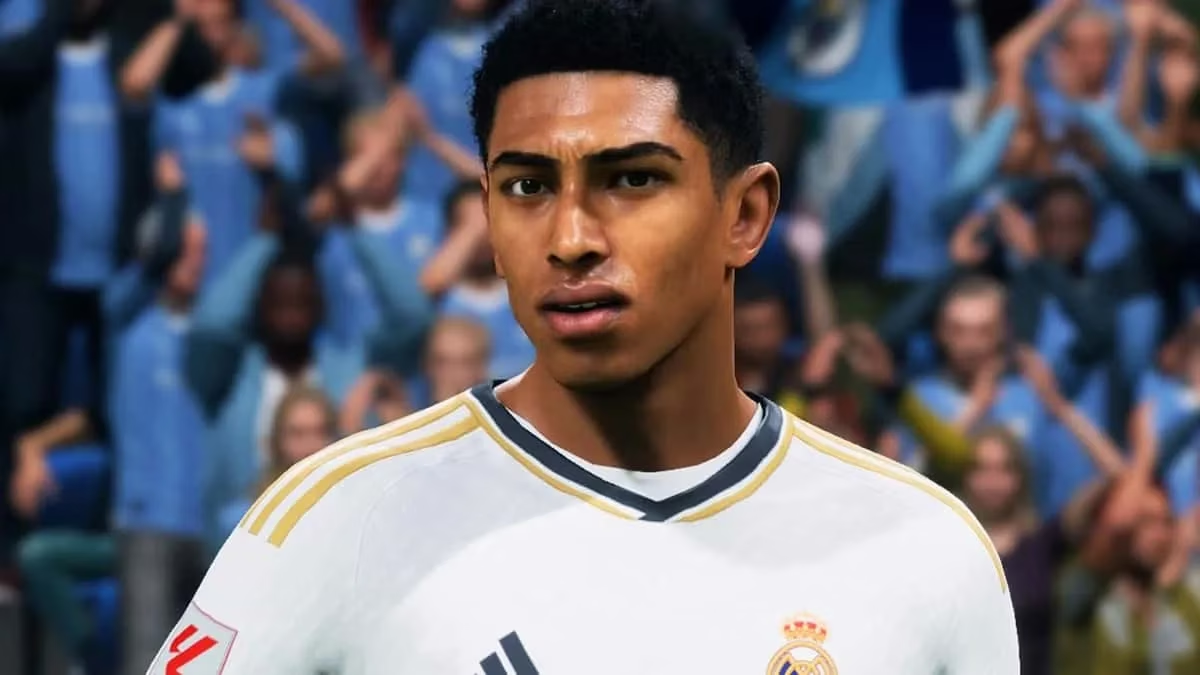
The Team of the Year promo that dropped alongside the update was nothing short of spectacular. A galaxy of stars landed in packs: Mohamed Salah gliding down the wing with his left foot already curled into a finesse shot, Rodri dictating play like a midfield metronome, and William Saliba locking down the backline with those impossibly long strides. If that wasn’t enough to send the market into a frenzy, EA also handed every single player a free 90-rated Zinedine Zidane ICON card. Not just a loan, mind you – a permanent Zizou that could be grinded up to a 94 overall, complete with that iconic bald head and magical five-star skill moves.
Community sentiment soared. For once, the patch notes were a love letter to the players. Long-standing issues with defensive AI positioning and inconsistent finishing had been tweaked, making the gameplay feel crisp and responsive. Pro players and casuals alike flooded social media with rare praise. One content creator even called it “liquid football made digital.” The mood was so positive that EA could have just sat back, let the TOTY revenue roll in, and called it a season.
But then came the TOTY Cup objective, a requirement that seemed innocent on paper: score two goals in eight separate matches of the Friendlies mode.
To understand why this caused such a meltdown, you have to get inside the head of an Ultimate Team grinder. Friendlies in FC 25 have always been the chill-out zone, the virtual equivalent of a five-a-side game where nobody really minds the scoreboard. Over the years, a beautiful unwritten rule took root, nicknamed Golden Goal. If you conceded first, you simply paused and left. No hard feelings. It allowed everyone to finish objectives at lightning speed, because why waste time playing a full match when your only goal is to notch a single assist with a Moroccan Silver card? Friendly matches didn’t affect your win-loss record, they didn’t count towards your players’ goal stats, so quitting early was a victimless act of time efficiency. It was a handshake agreement that kept the machine running smoothly.
Then EA made that agreement feel like a trap.
“People are going to leave at 1-0, and this whole challenge will be impossible,” one exhausted player sighed on forums, staring at an objective screen that suddenly required eight separate games with two goals scored. The problem was brutally obvious: in a Golden Goal world, scoring two goals in a match is a rare luxury. Most games end 1-0 and a handshake. By setting the bar at two goals across eight different matches, EA effectively forced players to either plead for cooperation from strangers or, more likely, slog through full-length friendlies against opponents who might refuse to quit even if the score turned into a tennis set.
“That’s totally bullshi*,” another commenter erupted, the asterisk doing very little to hide the frustration. That simple, raw line became the rallying cry for a player base that felt betrayed. It was as if EA had looked at the Golden Goal tradition and said, “How cute. Now stop it.”
Desperation bred creativity, as it often does in this community. Some hopeful souls proposed a new meta-treaty: each player would deliberately score an own goal at kick-off to get the scoring requirements out of the way, then resume a normal Golden Goal match from 1-1. It was a noble idea, a little like two boxers agreeing to tap each other lightly before the real fight. The problem? You only had a 50/50 chance of your opponent reading the social media posts suggesting this, and an even smaller chance they wouldn’t just celebrate their gifted goal and play toxic keep-ball for the next 90 minutes. The likelihood of this cooperative anarchy actually working was, to put it kindly, lower than packing a TOTY from a bronze pack.
Thankfully, the objective was entirely optional. Nobody was forced to complete it to access something crucial, like the full Zidane upgrade or the juiciest packs. Still, it stung. The resentment wasn’t really about a single objective; it was about the principle. The devs had waltzed into the Friendly mode’s living room, rearranged the furniture, and told everyone how to sit. Players felt they were being dictated to, that a long-standing community-crafted efficiency hack was now being treated as an exploit rather than a charming quirk of the game’s culture.
Looking back from 2026, the TOTY Cup Golden Goal fiasco remains a legendary talking point in the FC series narrative. It showed that even the most universally praised patch can’t fully shield a developer from the backlash that comes when you ignore player-generated norms. The FC 25 Title Update 5 was indeed a masterpiece of gameplay tuning; the physics felt alive, the keepers were half-decent, and Zidane was a dream. But that one little objective screen, with its innocent “Score 2 goals in 8 separate matches,” proved that the unwritten rule book is sometimes more powerful than the code itself. And somewhere, a community manager probably still winces whenever someone mentions the word “TOTY Cup.”
The whole episode serves as a perfect snapshot of the eternal dance between game creators and game players. EA gave gifts \u2013 Salah, a free Zidane, a beautiful patch \u2013 and then, almost playfully, yanked the Golden Goal tradition. You could almost hear the collective exhale of millions of Ultimate Team enthusiasts realizing their cozy Friendlies shortcut had been rumbled. In the end, the objective probably got completed by those willing to grind the hard way, while the rest simply shrugged, reminded that in the ever-evolving theatre of football simulation, the audience sometimes writes the best scripts.